youth football conditioning drills pdf

Youth football conditioning is crucial for athlete development, focusing on safety and age-appropriate training.
PDF guides detail line, bag, and cone drills, emphasizing sprinting and agility.
Effective conditioning builds a foundation for success, minimizing injury risk, and maximizing performance throughout the season.
Prioritizing proper technique and gradual progression is paramount when implementing any conditioning program for young players.
A. The Importance of Conditioning for Young Athletes
Conditioning for young football players extends far beyond simply running laps. It’s about building a holistic athletic base, encompassing cardiovascular endurance, strength, agility, and flexibility – all vital for performance and injury prevention. A well-conditioned athlete is better equipped to handle the physical demands of the game, maintaining focus and technique even during fatigue.
PDF resources on youth football conditioning drills highlight the necessity of drills focusing on footwork, explosiveness, and change of direction. These aren’t just about speed; they’re about developing neuromuscular control, which is crucial for reacting quickly and safely on the field.
Furthermore, proper conditioning fosters a positive attitude towards physical activity, instilling healthy habits that extend beyond the football field. It teaches discipline, perseverance, and the importance of teamwork. Ignoring conditioning leaves young athletes vulnerable to strains, sprains, and more serious injuries, hindering their development and enjoyment of the sport.
Ultimately, investing in conditioning is investing in the long-term health and success of these young athletes.
B. Age-Appropriate Conditioning Principles
Conditioning drills for youth football must prioritize safety and developmental stage. Unlike adult programs, young athletes require a gradual approach, focusing on foundational movements and building a base before introducing complex or high-intensity exercises. PDF guides emphasize adapting drills to different age groups and skill levels.
For younger players, the focus should be on fun, engaging activities that develop fundamental motor skills – running, jumping, throwing, and catching. Drills should be short, frequent, and incorporate games to maintain interest. As athletes mature, intensity and complexity can be increased, but always with proper supervision and technique instruction.
Avoid excessive emphasis on weightlifting or highly specialized training at a young age. Instead, prioritize bodyweight exercises, agility drills, and core strengthening. Remember, the goal is to develop well-rounded athletes, not just football players.
Overdoing it can lead to burnout, injuries, and a negative association with physical activity. Age-appropriate conditioning fosters a lifelong love of fitness.
C. Safety Considerations in Youth Football Conditioning
Youth football conditioning demands a paramount focus on safety. PDF resources highlight the importance of proper warm-up and cool-down routines to prevent injuries. Coaches must prioritize athlete well-being above all else, ensuring drills are appropriately supervised and modified for individual needs.
Hydration is critical, especially during warmer months. Frequent water breaks should be mandatory, and athletes should be educated about the signs of dehydration. Proper equipment fitting is also essential, including helmets, pads, and footwear. Regularly inspect equipment for damage and ensure it meets safety standards.
Coaches should be trained in first aid and CPR, and a medical professional should be present at practices and games. Be aware of pre-existing medical conditions and allergies. Avoid pushing athletes beyond their limits, and encourage them to communicate any pain or discomfort.
Creating a safe environment fosters confidence and allows young players to develop their skills without unnecessary risk.

II. Pre-Season Conditioning Drills
Pre-season conditioning builds a base for the demands of football. PDF guides emphasize cardiovascular endurance, dynamic warm-ups, and core strength development for stability and injury prevention.
A. Building a Base: Cardiovascular Endurance

Cardiovascular endurance is the cornerstone of any successful pre-season conditioning program for youth football players. A strong aerobic base allows athletes to sustain effort throughout practices and games, reducing fatigue and improving overall performance. PDF resources highlight the importance of gradually increasing the duration and intensity of cardiovascular workouts.
Begin with low-impact activities like jogging, running, and interval training. Interval training, specifically the 80/30 method mentioned in online resources, is highly effective. This involves 30 seconds of high-intensity effort followed by 2.5 to 4 times that duration in rest. This approach is beneficial as it allows for adequate recovery, particularly for linemen and younger players who may not yet have the stamina for prolonged exertion;
Progressively increase the work intervals and decrease the rest periods as fitness levels improve. Incorporate varied terrain, such as hills or uneven surfaces, to challenge the cardiovascular system further. Remember to prioritize proper form and technique to minimize the risk of injury. Consistent cardiovascular training during the pre-season will lay a solid foundation for more demanding drills later on.
B. Dynamic Warm-up Routines
Dynamic warm-ups are essential for preparing young athletes for the demands of football practice and games. Unlike static stretching, dynamic movements actively increase blood flow to muscles, improve range of motion, and enhance neuromuscular activation. PDF guides on youth football conditioning drills emphasize incorporating a variety of dynamic exercises.
Effective routines should include movements like high knees, butt kicks, leg swings (forward, backward, and lateral), arm circles, and torso twists. These exercises mimic the movements used in football, preparing the body for specific actions. Shuffling, backpedaling, and carioca drills, often found in PDF resources, are also excellent dynamic warm-up components.
Focus on controlled movements through a full range of motion. Avoid bouncing or jerky motions, which can increase the risk of injury. A well-executed dynamic warm-up will improve performance, reduce muscle soreness, and minimize the likelihood of strains or sprains. Prioritize quality over quantity, ensuring athletes perform each exercise with proper technique.
C. Core Strength Development for Stability
Core strength is foundational for youth football players, providing stability, power transfer, and injury prevention. A strong core enhances performance in all football-specific movements – tackling, blocking, throwing, and running. Youth football conditioning drills PDFs frequently highlight the importance of core work.
Effective core exercises for young athletes include planks (various modifications for different levels), side planks, bird dogs, and glute bridges. These exercises engage multiple core muscles simultaneously, building overall stability. Incorporate rotational movements like Russian twists (with or without a light weight) to improve power and agility.
Focus on proper form and controlled movements. Avoid exercises that place excessive stress on the spine. Begin with bodyweight exercises and gradually progress to more challenging variations as strength improves. A strong core isn’t just about “six-pack abs”; it’s about functional strength that translates to improved performance and reduced injury risk on the field.

III. In-Season Conditioning Drills
Maintaining fitness during the season requires strategic drills. PDFs suggest circuit training and short burst conditioning like 80/30 intervals to preserve endurance and speed.
These drills help players stay sharp without overexertion, crucial for peak performance.
A. Maintaining Fitness Levels During the Season

Maintaining peak physical condition throughout the football season is a delicate balance. Youth football conditioning PDFs emphasize that in-season work shouldn’t replicate the intensity of pre-season training, but rather focus on preserving the gains already achieved. The goal is to avoid overtraining and minimize the risk of injury when players are already experiencing the physical demands of games and practices.
Conditioning drills during the season should be shorter in duration and lower in volume compared to the pre-season phase. This approach helps to prevent fatigue accumulation and ensures players are fresh and ready to perform on game day. Incorporating active recovery techniques, such as light jogging or dynamic stretching, can also aid in maintaining fitness levels and promoting muscle recovery.
PDF resources highlight the importance of incorporating conditioning into regular practice routines, rather than dedicating separate, lengthy conditioning sessions. This integrated approach ensures that players are consistently challenged without being overwhelmed. The focus shifts from building endurance to maintaining it, allowing young athletes to stay competitive and perform at their best.
B. Short Burst Conditioning: 80/30 Interval Training
Interval training, specifically the 80/30 method, is a highly effective conditioning technique detailed in youth football conditioning PDFs. This approach involves alternating between 30 seconds of high-intensity effort – around 80% of maximum speed – and 30 seconds (or longer, up to 4x that duration) of rest or low-intensity recovery. This mimics the stop-and-start nature of football, improving players’ ability to repeatedly exert maximum effort with short recovery periods.
The benefit of this method, as noted in online resources like Reddit’s r/footballstrategy, is its adaptability. It’s time-based, ensuring all players, regardless of position or fitness level, receive comparable rest. This is particularly important for linemen and younger athletes who may struggle with distance-based drills.
Implementing 80/30 intervals can involve sprints, shuttle runs, or agility drills. The key is to maintain a high level of intensity during the work phase and utilize the recovery period for active rest, such as light jogging or walking. This method builds both anaerobic and aerobic capacity, crucial for football performance.
C. Circuit Training for Full-Body Conditioning
Circuit training, frequently outlined in youth football conditioning PDFs, provides a comprehensive approach to improving overall fitness. It involves performing a series of exercises – typically 6-10 – in a sequence with minimal rest between each exercise. After completing all exercises, a longer rest period is taken before repeating the circuit multiple times.
PlaySportsTV highlights the effectiveness of “up-downs” and other circuit drills for enhancing youth football players’ conditioning. These circuits can incorporate bodyweight exercises like push-ups, squats, lunges, and core work, alongside agility drills like cone weaves or shuttle runs.
The beauty of circuit training lies in its versatility. Coaches can tailor exercises to target specific muscle groups and energy systems. For example, a circuit focusing on explosive power might include jump squats and medicine ball throws, while one emphasizing endurance could feature high-rep bodyweight exercises and light cardio. Proper form and controlled movements are essential to prevent injuries.

IV. Specific Drill Categories
Youth football conditioning PDFs detail focused drill work. These categories include line, bag, and cone drills, emphasizing footwork, explosiveness, agility, and precision for players.
These drills build essential skills and physical attributes.
A. Line Drills: Focus on Footwork and Explosiveness
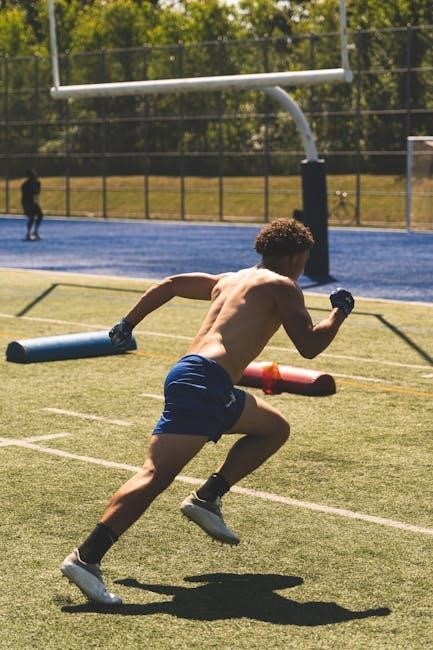
Line drills, as detailed in youth football conditioning PDFs, are foundational for developing quickness and power. These drills emphasize rapid footwork, explosive first steps, and the ability to maintain balance while changing direction. Common exercises include short-distance sprints within a defined line, shuffling drills to improve lateral movement, and backpedaling exercises to enhance defensive positioning.
The focus isn’t solely on speed; it’s about controlled agility. Players practice staying low to the ground, maintaining a strong base, and reacting quickly to simulated cues. Drills often incorporate cone placements to challenge players’ ability to navigate obstacles while maintaining speed and form. These drills are crucial for all positions, but particularly vital for linemen who require explosive power and precise footwork to effectively block or penetrate the line of scrimmage.
Proper technique is paramount to prevent injuries and maximize effectiveness. Coaches should emphasize correct body positioning and controlled movements throughout each drill.
B. Bag Drills: Agility and Change of Direction
Bag drills, frequently outlined in youth football conditioning PDFs, are designed to dramatically improve agility, change-of-direction speed, and footwork. These drills utilize a series of closely spaced bags or cones, forcing players to quickly navigate around obstacles while maintaining a low center of gravity and controlled movements.
Players typically perform various movements through the bags – shuffling laterally, sprinting forward, backpedaling, and incorporating quick cuts and turns. The objective is to react swiftly to the changing layout and maintain balance throughout each maneuver. These drills simulate the unpredictable movements required during a game, preparing players to evade defenders or pursue ball carriers effectively.
Variations include adding a ball to the drill, requiring players to maintain control while navigating the bags, further enhancing coordination. Emphasis should be placed on keeping the head up, maintaining a strong base, and avoiding crossing the feet to prevent injuries.
C. Cone Drills: Speed and Precision
Cone drills, a staple in youth football conditioning PDFs, are invaluable for developing speed, acceleration, precision, and overall agility. These drills utilize cones strategically placed to create various patterns, challenging players to navigate them with controlled bursts of speed and accurate footwork.
Common cone drill variations include weaving through cones in a straight line, performing figure-eight patterns, or setting up more complex courses that require quick changes in direction. Players focus on maintaining a low center of gravity, driving through each turn, and minimizing wasted movement. The emphasis is on explosive acceleration and precise foot placement.
PDF resources often detail specific cone drill layouts and timings, providing benchmarks for players to strive for. Coaches can modify drill complexity to suit different skill levels, ensuring progressive overload and continuous improvement. These drills directly translate to on-field performance, enhancing a player’s ability to quickly react and make plays.

V. Agility and Speed Drills
Agility and speed drills, detailed in youth football conditioning PDFs, enhance quickness and lateral movement.
Shuttle runs, carioca, and weaving drills improve coordination and reaction time.
A. Shuttle Runs: Lateral Movement and Quickness
Shuttle runs are a cornerstone of youth football conditioning drills, as outlined in many PDF guides. These drills dramatically improve an athlete’s ability to change direction quickly, a vital skill for all positions on the field. The standard shuttle run involves sprinting to a designated point, touching the line, and then sprinting back to the starting point, repeating this process across multiple points.
Variations can include pro agility shuttles (5-10-5), focusing on a more football-specific cutting motion. Coaches should emphasize maintaining a low center of gravity throughout the drill, promoting balance and efficient movement. Proper technique – quick feet, explosive steps, and controlled stops – is more important than sheer speed initially.
PDF resources often suggest incorporating cones to mark the turning points, ensuring consistent distances. Monitoring rest periods is crucial to prevent fatigue and maintain form. Shuttle runs build not only speed but also crucial lateral quickness, essential for evading defenders or pursuing ball carriers.

B. Carioca Drills: Hip Mobility and Coordination
Carioca drills, frequently detailed in youth football conditioning drills PDF guides, are excellent for enhancing hip mobility, coordination, and lateral agility. This drill involves weaving in and out while maintaining a slightly athletic stance, crossing one foot in front and then behind the other as you move laterally.
The movement pattern challenges athletes to coordinate their upper and lower bodies, improving overall body control. PDF resources often recommend starting with a slow, controlled pace, focusing on proper technique before increasing speed. Coaches should emphasize keeping the feet low to the ground and maintaining a consistent rhythm.
Variations can include adding a ball to the drill, requiring players to maintain control while performing the carioca. This drill is particularly beneficial for defensive backs and linebackers who need to quickly change direction and react to opponents. Consistent practice improves hip flexibility and prepares athletes for the demands of the game.
C. Weaving Drills: Agility and Ball Control (if applicable)
Weaving drills, commonly found within youth football conditioning drills PDF resources, are designed to improve agility, change-of-direction speed, and, crucially, ball control – particularly for offensive positions. These drills typically involve navigating a series of cones or markers in a zig-zag pattern, demanding quick footwork and precise movements.
PDF guides often illustrate variations, including those where players must maintain possession of a football while weaving. This adds a layer of complexity, forcing athletes to coordinate their hand-eye coordination with their agility. Coaches should emphasize a low center of gravity and short, choppy steps to maximize speed and control.
The drill effectively simulates the unpredictable movements required during a game, preparing players to evade defenders or create separation. Progressive difficulty can be introduced by decreasing the distance between cones or increasing the speed of execution. Mastering weaving drills translates to improved performance on the field.

VI. Conditioning Games & Fun Drills
Conditioning games, like tag football or running plays against backups, enhance fitness playfully. PDF resources suggest up-downs and circuits for engaging, effective conditioning.
These drills build stamina and teamwork while keeping young athletes motivated and enjoying their training sessions.
A. Run Play Between Themselves and Back Ups
Utilizing a “run play between themselves and backups” drill is a fantastic method for integrating conditioning with football-specific movements. This approach, highlighted in various resources discussing youth football conditioning drills, offers a dynamic and engaging way to improve stamina and game awareness.
The concept is simple: players run offensive plays against a second unit, effectively extending practice time with built-in conditioning. This isn’t just about sprinting; it’s about maintaining form and execution while fatigued, mirroring game conditions. A one-hour friendly game, as suggested by Quora responses, provides ample opportunity for this.
PDF guides on football drills often emphasize the importance of replicating game scenarios in conditioning. This drill achieves that by demanding players execute plays – blocking, running routes, tackling – while under physical stress. It’s a practical way to build endurance without resorting to monotonous laps. Coaches can adjust the pace and complexity to suit different age groups and skill levels, ensuring a safe and productive workout.
Furthermore, it fosters leadership and communication as players adjust to different teammates and play calls. It’s a win-win: conditioning and skill development combined!
B. Up-Downs and Circuit Drills
Up-downs and circuit drills represent a cornerstone of youth football conditioning, offering a versatile and effective method for building full-body strength and endurance. PlaySportsTV’s coaching resources specifically highlight these drills as valuable tools for improving player conditioning during practice sessions.
Up-downs, a classic exercise, combine a push-up with a jump, demanding both upper body strength and explosive power. When integrated into a circuit, alongside exercises like burpees, mountain climbers, and shuttle runs, they create a challenging and comprehensive workout. PDF guides detailing football conditioning often include variations of these circuits, tailored to different age groups and fitness levels.
The beauty of circuit training lies in its adaptability. Coaches can customize the exercises, repetitions, and rest periods to target specific muscle groups and energy systems. This ensures players develop the stamina needed to perform throughout an entire game.
These drills are particularly beneficial for younger athletes as they build a solid foundation of fitness without requiring specialized equipment or extensive coaching expertise. They’re a simple, yet powerful, way to enhance conditioning.
C. Tag Football Games for Conditioning
Tag football games offer a dynamic and engaging approach to youth football conditioning, seamlessly blending fun with fitness. Quora discussions suggest incorporating friendly, hour-long games where players run plays against each other and backups, providing sustained cardiovascular exercise and reinforcing fundamental skills.
Unlike traditional, highly structured drills, tag football encourages continuous movement, quick changes of direction, and strategic thinking. This mimics the demands of a real game, preparing players for the unpredictable nature of football. The competitive element also boosts motivation and participation.
While PDF guides on football conditioning often focus on specific drills, integrating game-like scenarios like tag football is invaluable. It allows coaches to assess players’ fitness levels in a practical context and identify areas for improvement.
This method is particularly effective for younger athletes, fostering a love for the game while simultaneously building endurance, agility, and teamwork skills. It’s a win-win scenario for both players and coaches.
VII. Cool-Down and Recovery
Cool-down routines, including static stretching, are vital post-conditioning. Hydration is key, alongside active recovery techniques, to reduce soreness and aid muscle repair.
A. Static Stretching for Flexibility
Static stretching is a cornerstone of any effective cool-down routine following youth football conditioning drills. Unlike dynamic stretching, which is best suited for warm-ups, static stretches involve holding a stretch in a challenging, yet comfortable, position for a sustained period – typically 15 to 30 seconds. This method helps to gradually lengthen muscles and improve overall flexibility.
Focus on major muscle groups utilized during football activities, including the hamstrings, quadriceps, groin, calves, and shoulders. Examples include hamstring stretches (touching toes or using a towel), quad stretches (pulling the heel towards the glutes), and calf stretches (leaning against a wall).
Proper form is crucial to avoid injury. Encourage players to breathe deeply and avoid bouncing during the stretch. Static stretching not only enhances flexibility but also aids in reducing muscle soreness and improving range of motion, contributing to long-term athletic performance and injury prevention. A PDF guide on conditioning drills should emphasize these points.
B. Importance of Hydration
Hydration is absolutely critical during and after youth football conditioning drills, often underestimated but profoundly impactful on performance and safety. Young athletes are particularly vulnerable to dehydration due to their higher metabolic rates and inability to regulate body temperature as efficiently as adults. Dehydration can lead to decreased performance, muscle cramps, heat exhaustion, and even heatstroke.
Encourage players to drink water before, during, and after all conditioning activities. Avoid sugary drinks and juices, as they can hinder hydration. A good rule of thumb is to drink water every 15-20 minutes during drills.
A comprehensive youth football conditioning drills PDF should explicitly outline a hydration plan. Monitoring urine color can be a simple indicator of hydration status – pale yellow indicates good hydration, while dark yellow suggests dehydration. Prioritizing hydration is a fundamental aspect of athlete care and contributes significantly to a safe and productive training environment.
C. Active Recovery Techniques
Active recovery is a vital component often overlooked in youth football conditioning drills, yet it significantly enhances recovery and reduces muscle soreness. Unlike passive rest, active recovery involves low-intensity movements that promote blood flow and help clear metabolic waste products from muscles.
Examples of active recovery techniques include light jogging, walking, dynamic stretching, and foam rolling. A well-structured conditioning drills PDF should incorporate these methods into cool-down routines. These techniques aid in restoring muscle function and preparing athletes for subsequent training sessions.
Implementing short, low-intensity activities post-drill helps prevent stiffness and accelerates the recovery process. Active recovery isn’t about pushing limits; it’s about facilitating the body’s natural healing mechanisms. Prioritizing active recovery ensures athletes remain healthy, energized, and ready to perform at their best.